


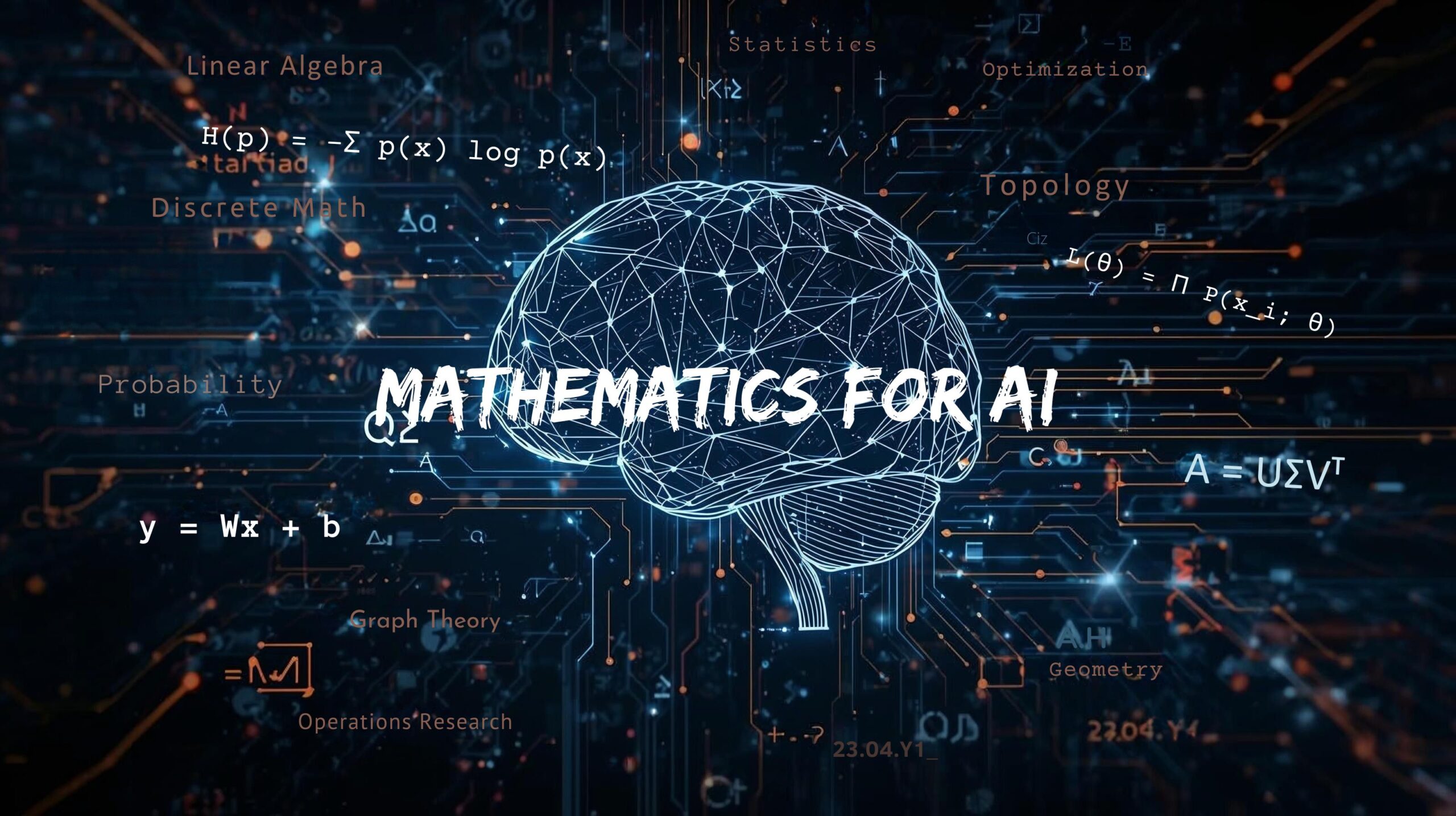
For AI experts, Architects, and Technical Leaders, the mathematics underpinning artificial intelligence is far more than academic theory—it is the operating system for innovation. While advanced models sometimes appear as opaque “black boxes,” their capabilities, limitations, and future evolution are fundamentally governed by four core mathematical disciplines: Linear Algebra, Calculus, Probability & Statistics, and Discrete Math/Graph Theory.
This article moves beyond foundational overviews to provide a strategic analysis of how these areas synergize in modern systems, their scaling challenges, and their evolving role in the next frontier: AI-enabled reasoning. We integrate insights from leading mathematicians and industry trends to offer a practical framework for skill investment and strategic R&D planning, positioning these mathematical toolkits as the critical differentiator between using AI and truly advancing it.
The Four Pillars of Mathematics for AI
1. Linear Algebra: The Architecture of Data
Linear algebra provides the foundational structures—vectors, matrices, and tensors—to represent and manipulate data at scale. It is the language in which all data, from pixels to protein sequences, is translated for computational processing.
- Core Function: It enables the high-dimensional data representations and transformations essential for deep learning. Every operation in a neural network’s forward pass—from applying convolutional filters to images to the attention mechanisms in transformers—is a sequence of linear algebra computations.
- Strategic Applications: Beyond basic operations, techniques like Singular Value Decomposition (SVD) and Principal Component Analysis (PCA) are critical for efficiency. They compress massive datasets into their most informative features, reducing computational cost and mitigating the “curse of dimensionality”. For instance, PCA is fundamental in facial recognition systems to distill key facial features from raw pixel data.
2. Calculus & Optimization: The Engine of Learning
If linear algebra structures the data, calculus and optimization provide the mechanism for learning from it. The core process of training—adjusting millions of parameters to minimize error—is an optimization problem solved through calculus.
- The Gradient Descent Paradigm: The derivative lies at the heart of learning, measuring how a model’s error changes with respect to each parameter. Gradient descent uses this gradient to navigate the complex error landscape of a model, iteratively stepping toward minimum error. The chain rule of calculus makes this computationally feasible for deep networks through backpropagation, efficiently distributing error corrections backward through every layer.
- Beyond the Basics: Modern deep learning employs advanced variants like Adam or RMSprop, which adapt the learning rate for each parameter, leading to faster and more stable convergence. A 2025 industry analysis indicates that novel optimization techniques are now a primary lever for reducing the massive computational cost of training frontier models.
3. Probability & Statistics: The Framework for Uncertainty
Real-world data is noisy and incomplete. Probability and statistics equip AI with the tools to reason under uncertainty, quantify confidence, and make robust inferences.
- From Bayesian Thinking to Modern Inference: Bayesian inference provides a powerful framework for updating beliefs (probabilities) as new evidence arrives, crucial for adaptive systems. Meanwhile, Maximum Likelihood Estimation (MLE) is a workhorse for training models by finding parameters that make the observed data most probable.
- Evaluation and Information Theory: Statistics provides the rigor for model evaluation through hypothesis testing and confidence intervals. Furthermore, concepts from information theory, like entropy and Kullback-Leibler (KL) divergence, are not just theoretical. Entropy measures uncertainty in predictions, and KL divergence is used directly in training generative models and ensuring their outputs align with real-world data distributions.
4. Discrete Math & Graph Theory: The Logic of Relationships
While the first three pillars excel with continuous, numerical data, many problems involve discrete structures and complex relationships. This is the domain of discrete mathematics and graph theory.
- Modelling Interconnected Systems: Graphs (nodes and edges) naturally model social networks, knowledge graphs, supply chains, and molecular structures. Graph Neural Networks (GNNs) leverage this to perform reasoning and prediction on relational data, powering recommendation systems at companies like Spotify and Netflix.
- The Bridge to Symbolic Reasoning: This area is pivotal for advancing AI reasoning. It provides the formal language for logic, constraints, and compositional thinking, which is essential for moving beyond pattern recognition to structured problem-solving in areas like scheduling, automated theorem proving, and complex system design.
Synergy in Practice: How the Pillars Interact
The true power emerges in integration. Consider a recommendation system:
- Linear Algebra represents users and items as vectors in a shared latent space (matrix factorization).
- Calculus & Optimization trains the model by minimizing the error between predicted and actual user preferences via gradient descent.
- Probability & Statistics quantify the uncertainty of each recommendation and evaluate the model’s performance via A/B testing.
- Graph Theory can enhance it by modelling the social network of users, adding a layer of relational reasoning to the recommendations.
The Roadmap: Building Your Mathematical Toolkit
Your learning path should align with your professional role and aspirations. Foundational mathematics for AI is non-negotiable for practitioners.The following table outlines a strategic progression:
| Career Pathway | Foundational Stage (0-6 Months) | Intermediate Stage (6-18 Months) | Advanced/Strategic Stage (18+ Months) |
| AI Engineer / Practitioner | Linear Algebra: Vectors, matrices, operations, PCA. Calculus: Derivatives, gradients, intuitive grasp of backprop. Probability & Stats: Common distributions, Bayes’ Theorem, hypothesis testing. | Optimization: Deep dive into SGD, Adam, regularization. Statistics: MLE, MAP, advanced model evaluation. Information Theory: Cross-entropy loss, KL divergence. | Specialized Math: Domain-specific math (e.g., differential geometry for robotics, Fourier analysis for signal processing). Efficiency Math: Advanced linear algebra for model compression/quantization. |
| Research Scientist / Frontier Developer | Master all Intermediate practitioner topics. | Advanced Probability: Stochastic processes, probabilistic graphical models. Discrete Math: Graph theory, combinatorics, formal logic basics. Advanced Calculus: Vector calculus, numerical methods. | Pure Math Connections: Topology, category theory for novel architecture research. Automated Reasoning: Dive into formal verification and automated theorem proving (e.g., Lean, Coq). |
The Future Trajectory: AI as Mathematical Co-Pilot
The relationship between AI and mathematics is becoming bidirectional. We are moving from using math to build AI toward using AI to discover new mathematics. This shift makes deep knowledge of mathematics for AI a strategic advantage. Leading mathematicians like Terence Tao and Timothy Gowers foresee a near future where AI transforms research.
- Experimental Mathematics at Scale: AI can act as a “computational test tube,” exhaustively testing millions of conjectures or exploring proof strategies, turning mathematics into a more experimental science.
- AI Co-authors and Verifiers: Systems are approaching the ability to translate human intuitive proofs into formally verified code and to suggest novel lemma or conjecture. DARPA’s expMath program and benchmarks like FrontierMath aim to create AI collaborators capable of tackling monumental problems.
- Addressing the Counter-Argument: Some contend that high-level APIs negate the need for deep mathematical knowledge. However, as AI moves into high-stakes, reasoning-heavy domains—autonomous systems, scientific discovery, strategic planning—the ability to understand, debug, and innovate at the mathematical level will be what separates leaders from followers. As one expert noted, the historical skepticism that computers could never master the intuition of chess has already been decisively disproven, and a similar trajectory is likely in mathematical reasoning.
Conclusion
For CTOs, tech leaders, and enterprise architects, investing in mathematical literacy is no longer just an R&D concern—it’s a strategic imperative. The next wave of AI value will come from systems that don’t just recognize patterns but reason, explain, and discover. These systems will be conceived and built by teams fluent in the combined language of these four mathematical disciplines.
At i-Qode Digital Solutions, we help organizations not only implement AI but also cultivate the deep technical understanding required to innovate with it. The future belongs to those who understand the engine, not just the driver’s seat.
Begin your strategic assessment today: Audit your team’s strengths across these four pillars. Identify where advanced mathematical capability could unlock your next competitive advantage. Partner with experts who can bridge the gap between cutting-edge mathematical innovation and transformative business application.
